
Porcupine bezoar, Calculus Bovis and Houzao are all animal stones commonly found in traditional medicine, so what actually sets them apart? Each forms in a different part of the animal, and each forms in its own way. This article compares the three by animal source, formation site and formation conditions, and looks more closely at how porcupine bezoar forms in the wild.
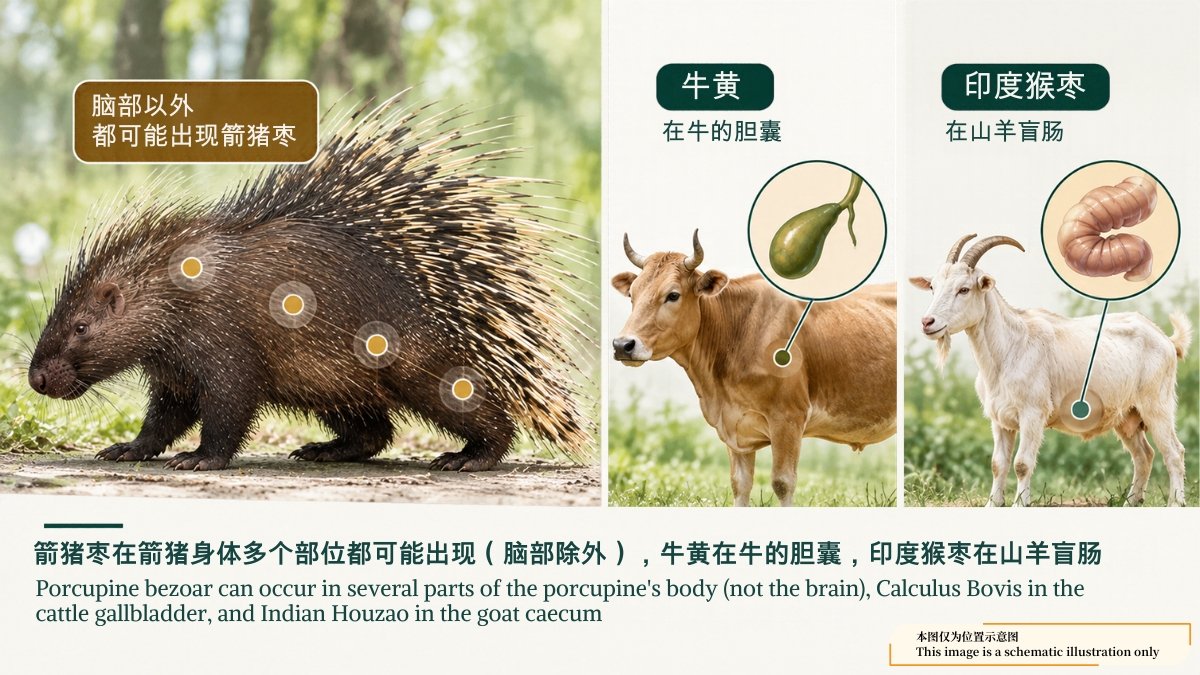
Porcupine bezoar (also known as porcupine date) is a stone that forms inside wild porcupines. It can occur in the digestive tract and other parts of the body; only the brain is never affected. Calculus Bovis and Houzao are also animal stones, but Calculus Bovis is a cattle gallstone. Houzao is traditionally said to come from monkeys, yet the Indian Houzao that dominates the market actually forms in the caecum of goats.
By animal source, formation site and composition, the three are clearly different:
| Porcupine bezoar | Calculus Bovis | Houzao | |
|---|---|---|---|
| Animal source | Wild porcupines | Cattle | Traditionally recorded as macaques and other monkeys; Indian Houzao comes from goats |
| Where it forms | Digestive tract and other parts of the body (not the brain) | Gallbladder and bile ducts | Indian Houzao: goat caecum |
| What it forms from | Undigested plant matter | Bile components that settle out | Layers built around a single acacia seed |
The Malayan porcupine is one of the porcupine species common in Southeast Asia. It is a herbivore that eats roots, tubers, bark and fallen fruit, and when injured, it will seek out natural herbs on its own to heal itself.
During digestion, some plant fibre cannot be fully broken down and gradually accumulates in the digestive tract. As this material keeps building up, it forms a hard stone: the porcupine bezoar.
Because the material builds up layer by layer, the cross-section of some porcupine bezoars shows a layered pattern. Historical texts also describe stones of this kind as wrapped in layers like an onion, shaped like an elongated acorn or an unripe date.
Porcupine bezoar does not only form in the digestive tract, though. Based on Miracle Medicine's extraction experience, it can occur in any part of the porcupine's body except the brain.
Not every porcupine forms a bezoar, and those that form naturally vary in size, shape and colour.
These differences relate to each porcupine's diet and internal conditions. Wild porcupines find their own food, so the plants each one eats, how it digests them and how material builds up all differ, and the stones that form show different characteristics as a result.
Appearance and internal composition are two separate things to observe, though. Colour, size and surface texture describe the outside, but they cannot directly tell you the active-essence content inside.

According to the Pharmacopoeia of the People's Republic of China, Calculus Bovis is the dried gallstone of cattle. It is found in the gallbladder or bile ducts and forms as components of bile gradually settle out.
Porcupine bezoar, by contrast, is not limited to one site: it can occur in the digestive tract and other parts of the body, except the brain. In research records, porcupine bezoars in the digestive tract are linked to plant matter that was eaten but not fully digested. In other words, Calculus Bovis comes only from the biliary system and is made from bile the animal secretes itself, while porcupine bezoar is not confined to one site, so the two form in clearly different ways.
Zhonghua Bencao (Chinese Materia Medica) records Houzao as a stone formed in the digestive tract of macaques and other monkeys. However, a study published in 2018 by a research team at Hong Kong Baptist University reported that Indian Houzao accounts for more than 95% of actual Houzao use on the market. Through field investigation in India, the researchers confirmed that this Houzao actually forms in the caecum of goats.
The study also found that Indian Houzao forms in layers around an acacia seed at its core inside the goat's caecum. Local herders also deliberately feed these seeds to their goats, which is quite different from the way wild porcupines forage on their own and form porcupine bezoars in nature.
Porcupine bezoar, Calculus Bovis and Houzao are all animal stones used in traditional medicine, but they differ in animal source and formation site.
Calculus Bovis forms mainly in the biliary system of cattle; Indian Houzao comes from the caecum of goats; and porcupine bezoar can occur in several parts of the porcupine's body (not the brain), with bezoars in the digestive tract forming as undigested plant matter gradually builds up.
Knowing these differences helps in understanding where each of these animal stones comes from and how it forms.
For questions about where our porcupine bezoar comes from, how it is extracted or which product grade to choose, contact the Miracle Medicine team directly.