
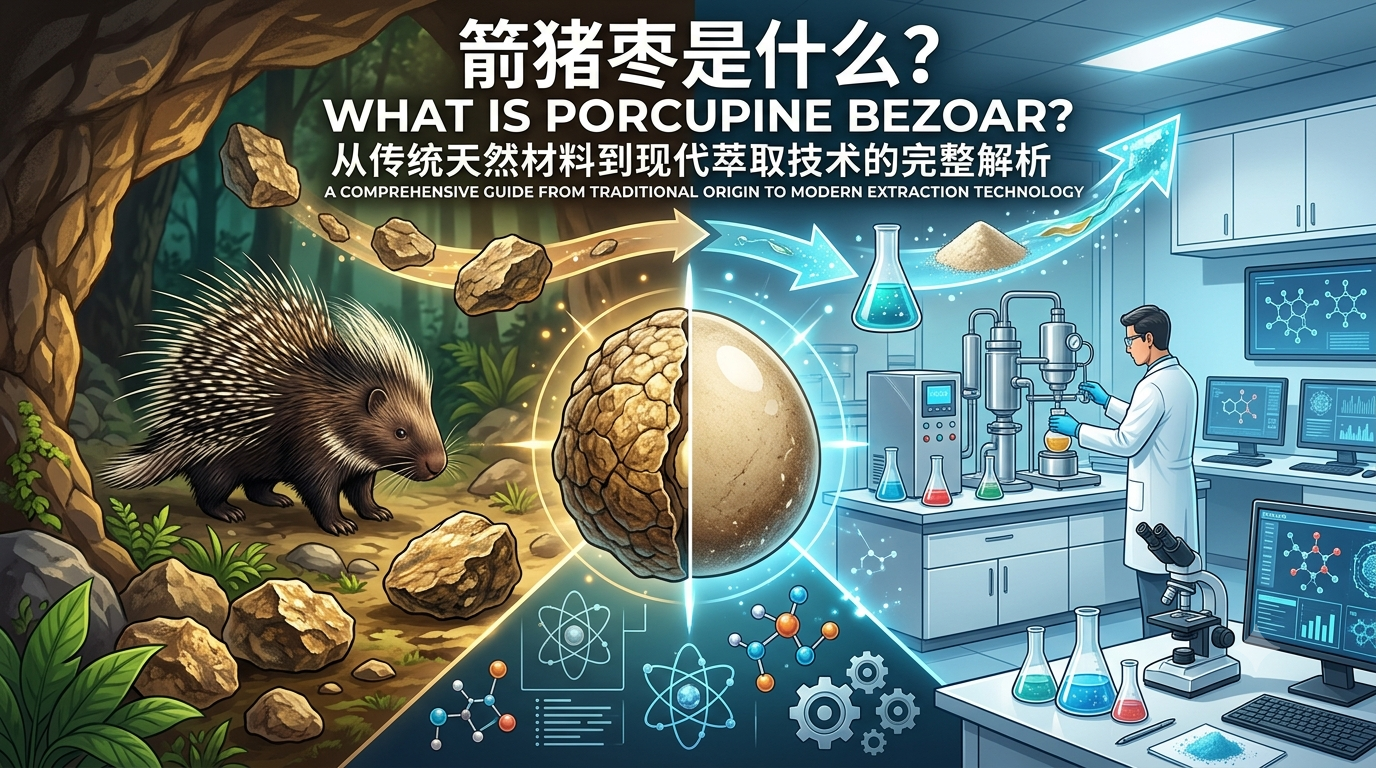
Porcupine bezoar (also known as porcupine date) is a natural stone formed inside a porcupine's body — not a bone, not an organ. The English name "bezoar" refers to any concretion formed in an animal's digestive tract; "porcupine" specifies the species. This guide covers the animal source, where in the body it forms, its traditional background across Southeast Asia, and why modern extraction technology changed how it is processed and verified.
Porcupine bezoar is a natural concretion that forms inside a porcupine (porcupine date is the common alternative name). It is composed of secretions, minerals and organic matter layered over time — found in some, but not all, individual animals. It is not a bone or organ. Sources are primarily wild forests in Indonesia and Southeast Asia.
The most widely used English name is porcupine bezoar. The word "bezoar" comes from Persian, meaning roughly "antidote stone" — historically it referred to any stony concretion found inside an animal's digestive tract. Cattle and sheep bezoars appear in Western medical history for the same reason. Adding "porcupine" specifies the species. The alternative name porcupine date is common in Malaysian and Singaporean Chinese communities, translated from the Chinese 箭猪枣. Both terms refer to the same material.
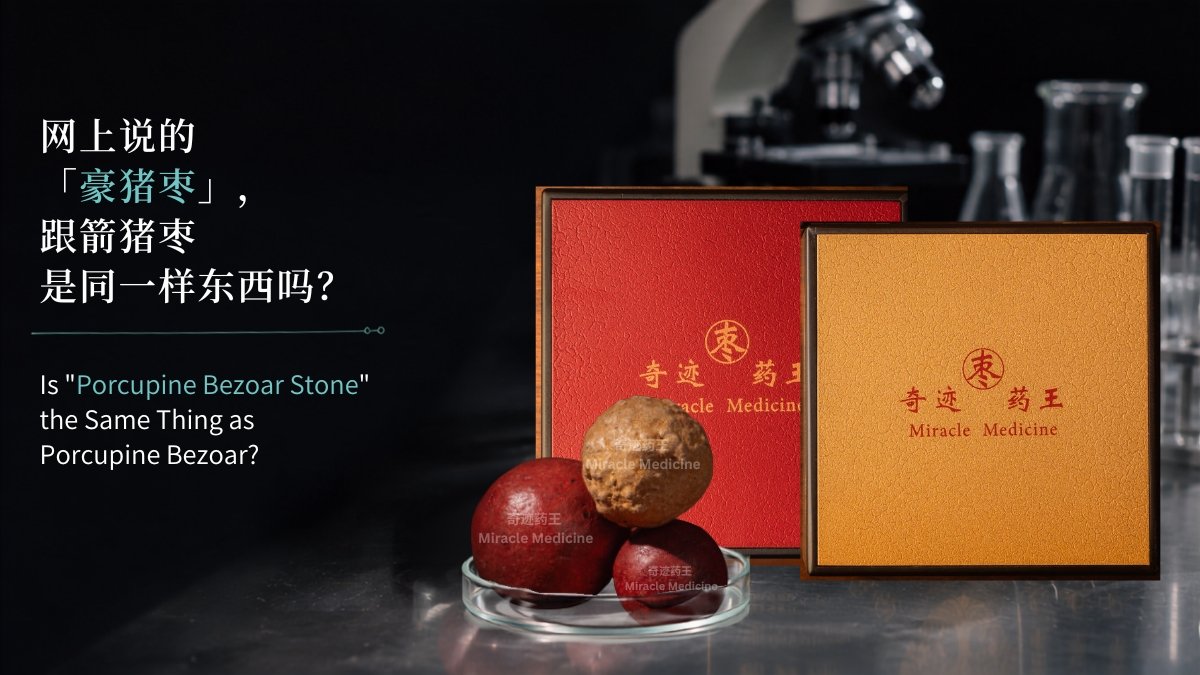
In Chinese, 箭猪枣, 河猪枣 and 豪猪枣 are all used in different regions — they are the same thing, not different grades or types.
Porcupine bezoar comes from the porcupine — a wild mammal covered in long, hard quills, found across Southeast Asia, Africa and South America. The Asian variety, which is the source of this material, is found mainly in the wild forests of Indonesia, Malaysia and Thailand.
It is not a hedgehog. Though both have spines, porcupines are considerably larger, and their quills — some exceeding 30 cm in certain species — are structurally different from a hedgehog's shorter, denser spines.
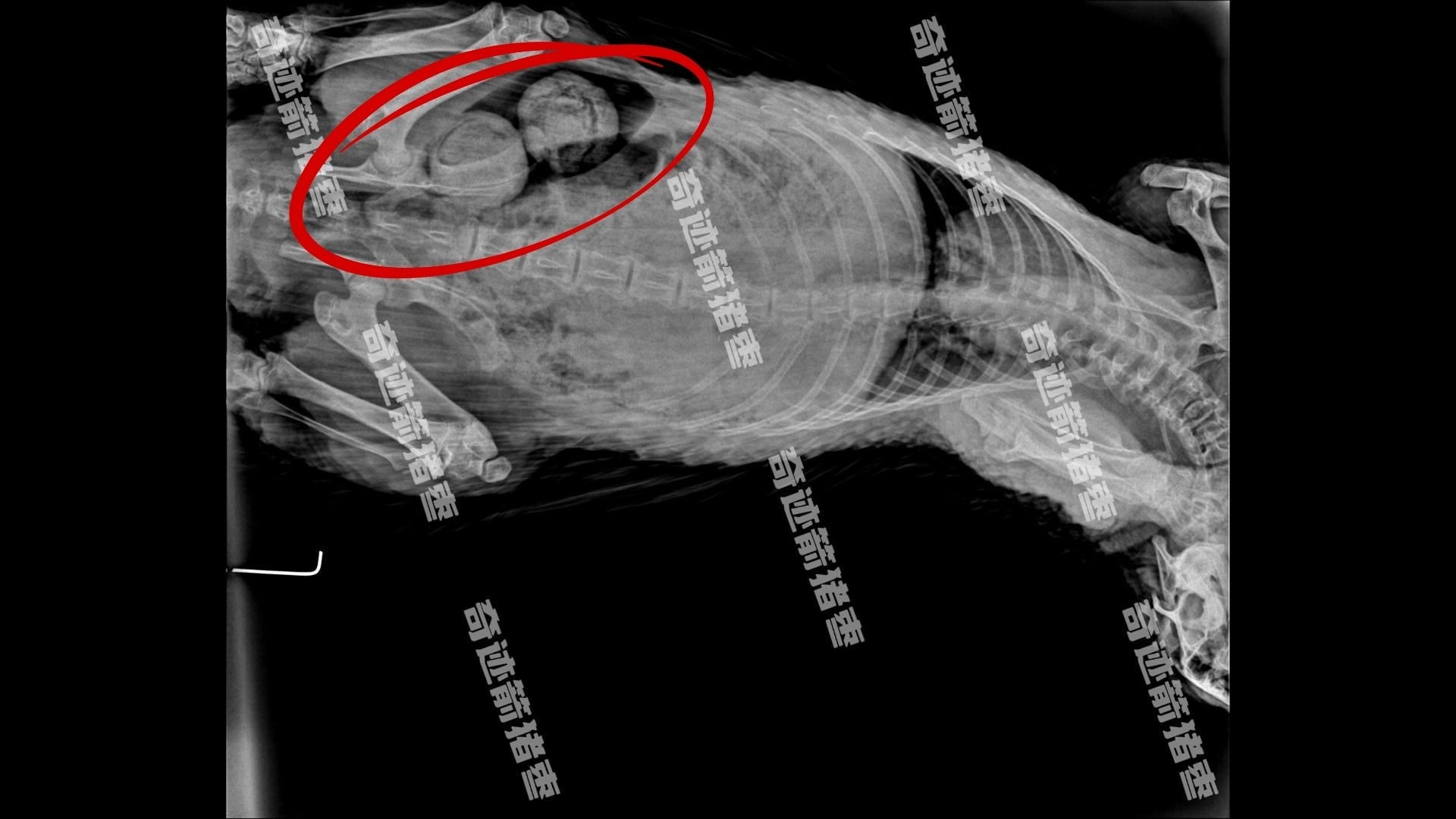
Miracle Medicine's porcupine bezoar is sourced from wild forests in Indonesia using a humane process — X-ray detection, veterinary surgical extraction, 2–4 weeks of post-operative recovery, and release back into the wild. A field and veterinary team of nearly 300 people manages the process. No animals are killed.
It is not a fixed organ or body part. Porcupine bezoar forms in the animal's digestive tract, where secretions, minerals and organic compounds gradually accumulate into a stone-like mass over time.
Not every porcupine carries one — some have none, others have several. The number and size varies considerably between individuals. This natural scarcity is one reason genuine porcupine bezoar carries a premium, and why the market also has a counterfeit problem.
In Chinese communities across Malaysia, Indonesia and Singapore, porcupine bezoar has a long history of use as a traditional natural material, typically taken to support the body through particular periods — illness, recovery, or high physical stress.
The basis for traditional use is accumulated folk knowledge and family memory, not systematically verified clinical evidence. Modern research is beginning to explore its composition and biological mechanisms from a scientific angle. That process is still at an early stage.
A 2026 animal-model study by Miracle Medicine and Guangdong Pharmaceutical University, published in Pharmaceuticals (DOI: 10.3390/ph19040563), observed immunomodulatory effects in rats. This is a starting point for further investigation — it cannot be directly extrapolated to human outcomes. Full research data and mechanism analysis are in our research section.
→ Read the full research breakdown 查看完整研究解析
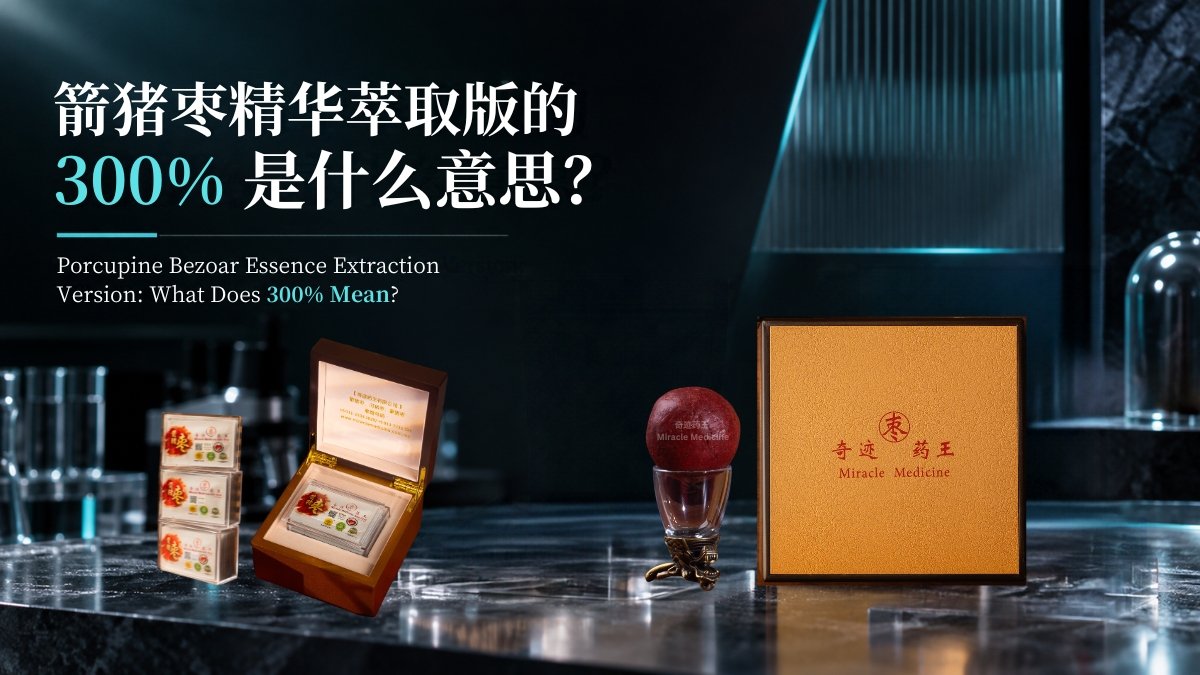
Traditional porcupine bezoar is ground into powder for consumption. Grinding changes particle size — it does not change the concentration of active components inside. Essence Extraction is a different process entirely. Through a sterile, controlled extraction process, active components are separated and concentrated from the raw material. The result is a measurably different product:
| Spec | Grade B | Grade A | Essence Extracted Version |
|---|---|---|---|
| Essence conc. | 60%(Baseline) | 90% | 300% |
| Impurity Ratio | 40% | 10% | 0% |
| Weight per pack | 0.4g | 0.4g | 0.4g |
| Absorption | Baseline | Baseline | ~3–4× traditional |
| Batch consistency | Natural variation | Natural variation | Stable every batch |
| Third-party tested | ✓ | ✓ | ✓ |
This is the most widely misunderstood aspect of porcupine bezoar.
Two pieces that look nearly identical on the outside — same colour, size, surface texture — can contain very different levels of active components. External appearance variables do not reflect internal fibre-particle density, which is what actually determines quality.
The significance of Essence Extraction technology is precisely this: it moves quality assessment from a subjective, eye-based judgement to a parameter that can be measured, compared, independently verified, and consistently reproduced from batch to batch. That is what standardisation actually means.
Miracle Medicine grades each piece by internal fibre-particle density — not colour. This is why different batches of traditional grades may vary in appearance while maintaining consistent grade classification.
Grinding and extraction are two fundamentally different processes. Grinding makes the material finer — it does not change the concentration of active components. Extraction, in a sterile controlled environment, actually separates and concentrates those components from the raw material.
Miracle Medicine's Essence Extraction was developed in collaboration with Guangdong Pharmaceutical University. The process operates under contamination-free conditions, achieving 300% essence concentration with 0% impurities. Every batch undergoes independent third-party testing.
Every body and every stage is different. Message Miracle Medicine directly, tell us your situation, and we'll help you think it through. Treatment decisions should always stay with your doctor.