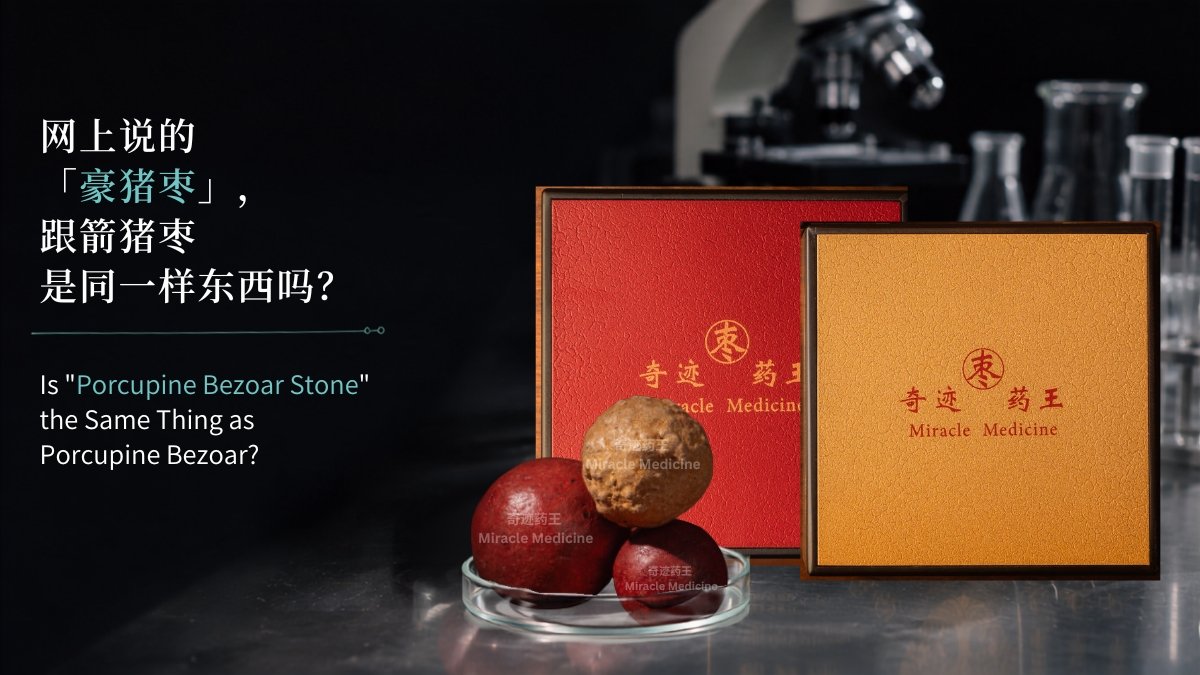

If you've come across the term "porcupine bezoar stone" in a search result, an AI-generated summary, or on certain English-language sites, you might wonder whether it refers to a different product. This article explains where the term comes from, and how it relates to porcupine bezoar, porcupine date, and the Chinese terms 箭猪枣, 河猪枣, and 豪猪枣.
Yes. "Porcupine bezoar stone" refers to the same thing as porcupine bezoar (also known as porcupine date, or 箭猪枣 / 河猪枣 / 豪猪枣 in Chinese). It is not a separate product — the added word "stone" simply describes the naturally formed concretion.
At first glance, "porcupine bezoar stone" reads like it might describe an actual rock or mineral. In English medical usage, however, "stone" carries a different, more specific meaning.
The section below explains that meaning first.
In this context, "stone" is used the way it is in medical English generally — to describe a concretion that forms inside the body, as in "kidney stone" or "gallstone."
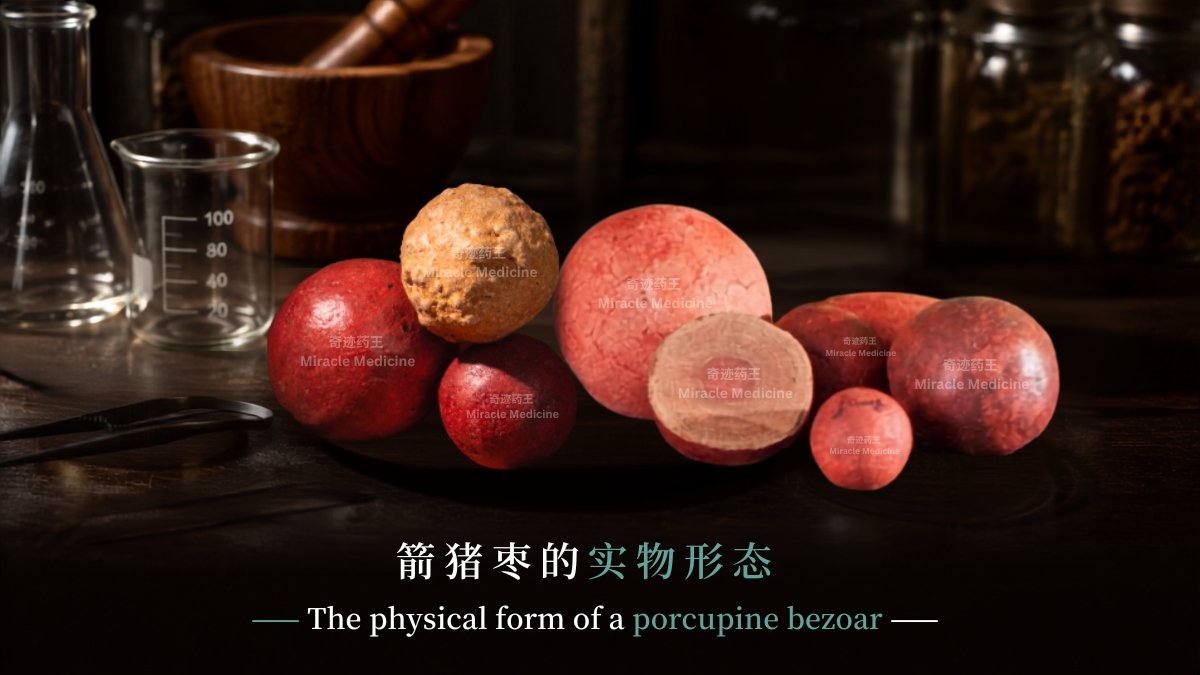
The word "bezoar" already carries this meaning on its own: it refers to a mass or concretion that forms in the digestive tract. Strictly speaking, "porcupine bezoar stone" is somewhat redundant. But because "bezoar" is not a widely familiar English word, adding "stone" helps readers immediately grasp that this is a concretion formed inside a porcupine's body — not a mineral picked up from the ground. That clarity is likely why the phrase has spread online.
The earliest clearly-sourced English academic reference is a paper by Christopher J. Duffin of the Natural History Museum, London, published in Pharmaceutical Historian. Its title is "Porcupine Stones" (2013, PMID 24620538).
The academic literature uses "porcupine stones," while the brand's standard English term is porcupine bezoar (also porcupine date). "Porcupine bezoar stone" is a combination of these two usages that has become common in online content over time — it is not the paper's original title, and not the brand's official term.
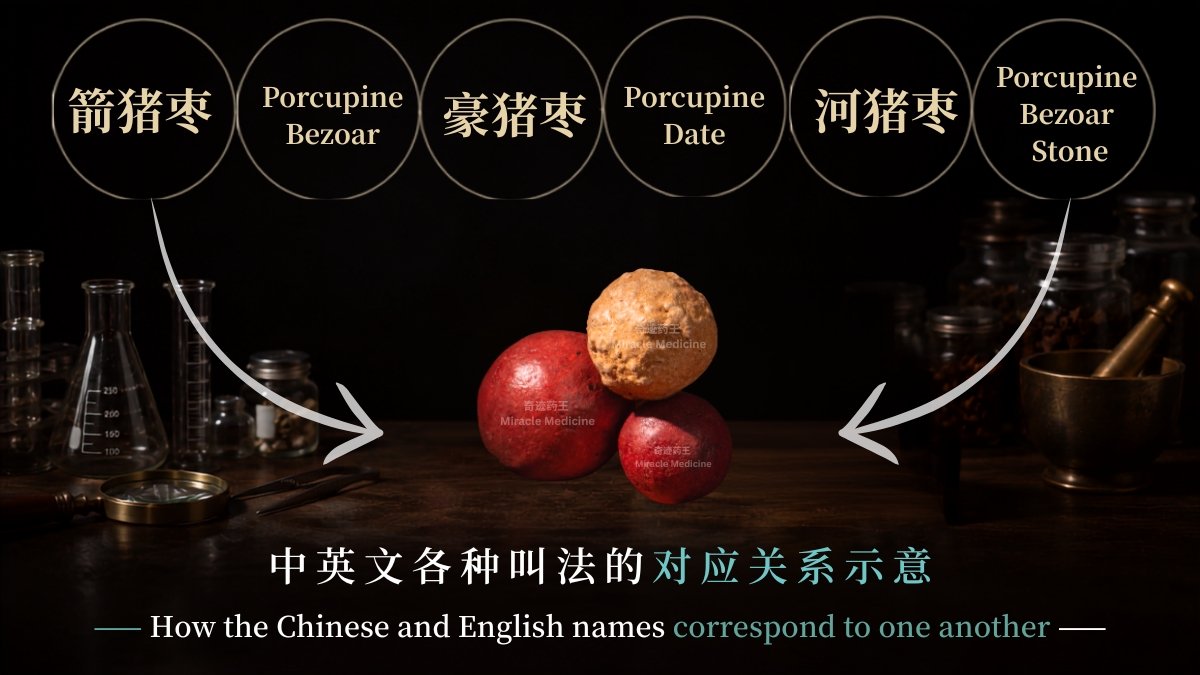
箭猪枣, 河猪枣, and 豪猪枣 are the three Chinese-language names for this material; porcupine bezoar and porcupine date are the two English names in common use. "Porcupine bezoar stone" refers to the same thing as all of these — the overlap simply comes from "bezoar" and "stone" carrying similar meaning.
Whether you encounter 箭猪枣, 河猪枣, 豪猪枣, porcupine bezoar, porcupine date, or porcupine bezoar stone, all of these terms point to the same naturally formed concretion found in porcupines.
For a complete breakdown of why the Chinese name has three variants, and how "bezoar" and "date" differ in English, see our companion article linked under Further Reading below.
In Chinese-language content, Miracle Medicine consistently uses 箭猪枣 (also known as 河猪枣 / 豪猪枣). In English, the brand's primary product name is porcupine date, with porcupine bezoar used as an alternative common term. "Porcupine bezoar stone" is not a name Miracle Medicine uses.
That said, as explained above, "porcupine bezoar stone" is a fairly common term online. If that is the phrase that brought you to this site, you can treat it as equivalent to what we call porcupine date / porcupine bezoar.
"Porcupine bezoar stone" reads like it could be a separate substance, but it isn't. Whether you encounter porcupine bezoar, porcupine date, porcupine stones, or the Chinese terms 箭猪枣, 河猪枣, and 豪猪枣, the name changes but the material is the same. The next time you see "porcupine bezoar stone," you can simply read it as porcupine bezoar.
If you've come across a name or explanation elsewhere that doesn't match what's on this page and you're not sure if it refers to the same thing, feel free to contact the Miracle Medicine team directly — we're happy to confirm.