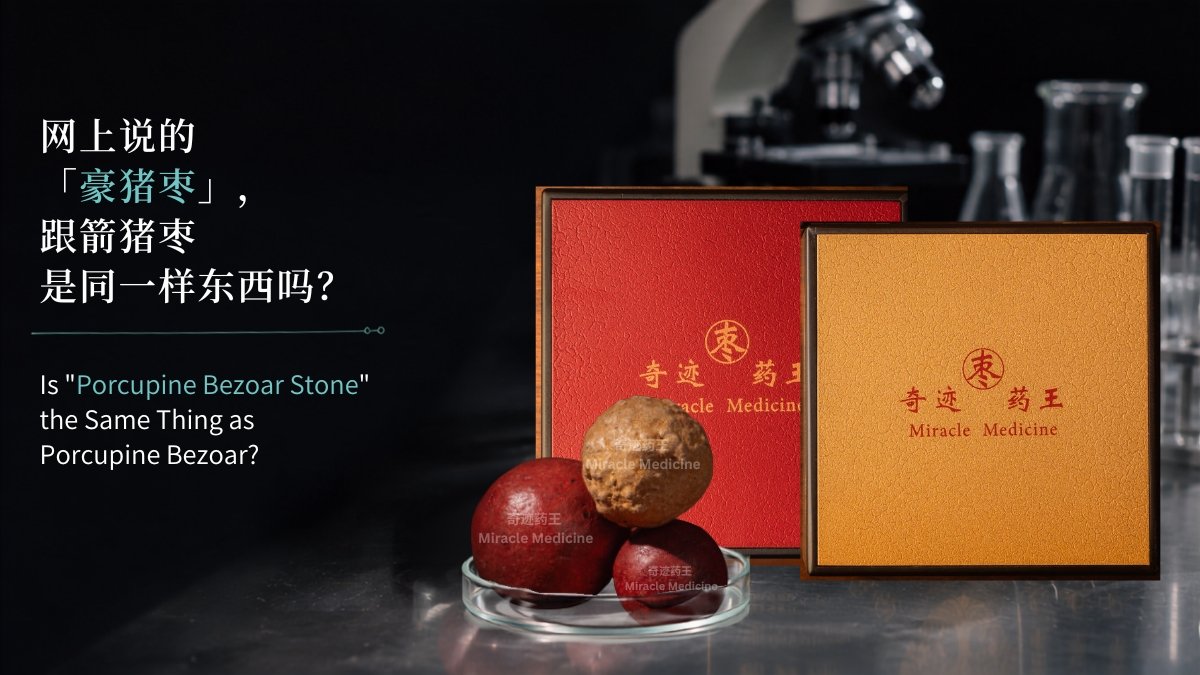

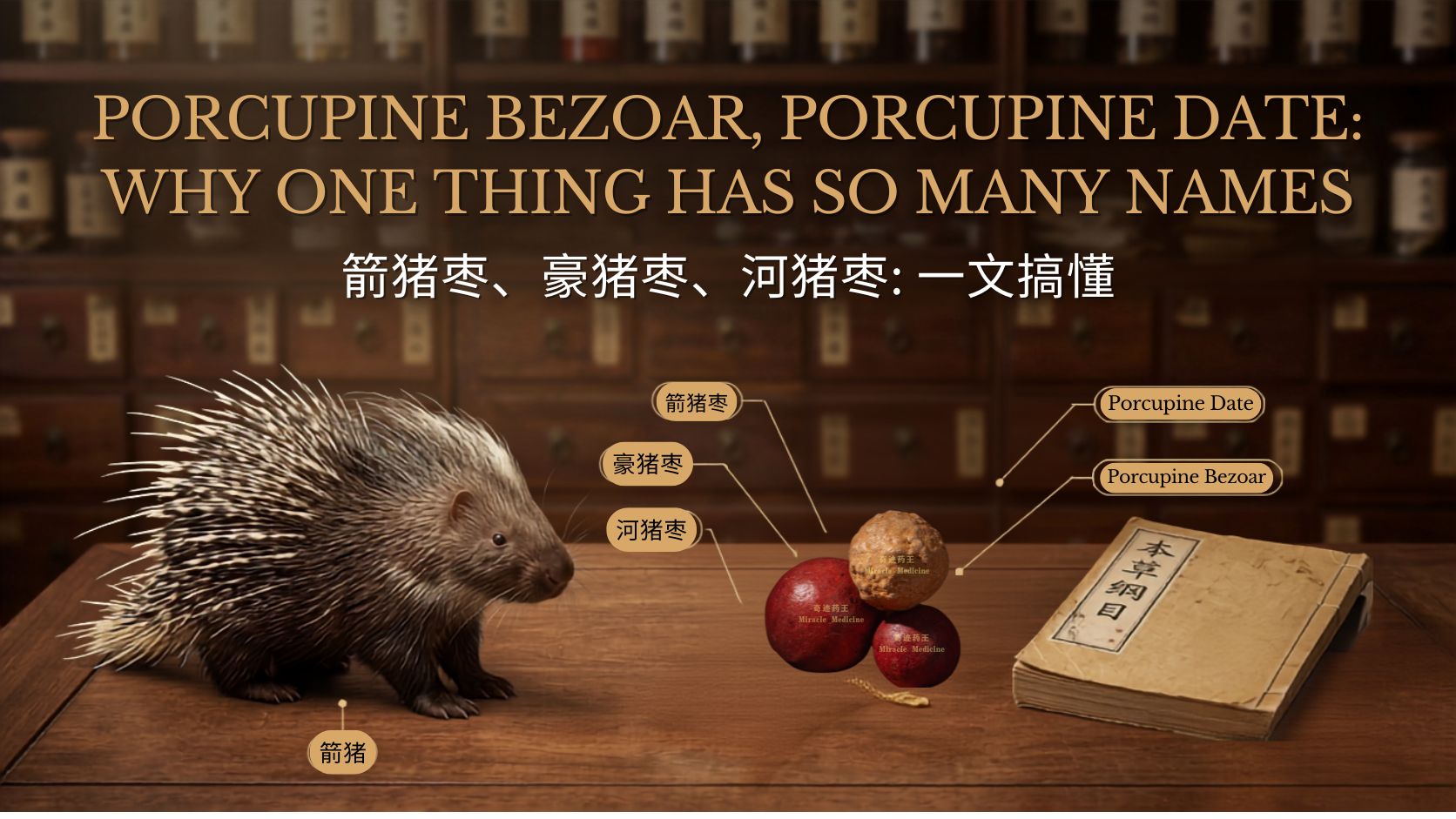
If the names have ever confused you — porcupine bezoar, porcupine date, and in Chinese 箭猪枣, 河猪枣, 豪猪枣 — this guide is for you. They all refer to the same thing. Here's every name laid out clearly, plus a correction for one mistranslation that's been spreading online.
Porcupine bezoar (also known as porcupine date) is a natural stone that forms inside a porcupine. In Chinese it's called 箭猪枣, 河猪枣, or 豪猪枣 depending on the region — all the same thing. The terms "arrowhead jujube" and "arrowpig jujube" that sometimes appear online are machine-mistranslations and refer to something else entirely, or to nothing at all.
Laid side by side, the names follow a clear logic:
| 名称 | 语言/地区 | 说明 |
|---|---|---|
| Porcupine 箭猪枣 | Chinese (common in Malaysia, Singapore) | The most widely used Chinese name |
| 河猪枣 | Chinese (some regions) | Same thing, regional variation |
| 豪猪枣 | Chinese (some regions, Hong Kong) | "豪猪" is another word for the porcupine |
| porcupine bezoar | English (formal / academic) | The most accurate English name |
| porcupine date | English (common / colloquial) | Literal translation of the Chinese "枣" (date); most common in everyday use |
five names, one substance. The differences are language, region, and register — not the product.
"箭猪" (arrow-pig) and "豪猪" (grand-pig) are two names for the same animal — the spiny wild mammal English calls a porcupine. Different Chinese-speaking regions favour different words, so 箭猪枣 and 豪猪枣 became synonyms. 河猪枣 is another regional variant. The differences come from local usage and dialect, not from any difference in quality, grade, or origin.
。
No. The "date" (枣) is purely a shape descriptor — its form and colour bring the date fruit to mind, so the name stuck. It's a natural stone that forms inside the porcupine, not a plant fruit, and has no botanical relationship to actual dates or jujubes. This surprises a lot of people the first time.
Both are in use, but they differ in precision.
Porcupine bezoar is the formal name. "Bezoar" comes from Persian, originally meaning "antidote stone," and broadly refers to a mass that forms naturally in an animal's digestive tract. Historically, stones from cattle and goats were also called bezoars. Adding "porcupine" specifies the version that comes from a porcupine. This is the most accurate term for academic or formal contexts.
Porcupine date is the everyday name. It's a direct translation of the Chinese 箭猪枣 — since 枣 means "date" (the fruit), 箭猪枣 becomes "porcupine date." This is the version most people in Malaysia and Singapore actually type into a search bar. It's less precise than "bezoar," but it points to the same thing.
The "date" in porcupine date refers to the date fruit (a shape descriptor), not a calendar date — and certainly not a romantic date. Some translation tools and AI assistants get confused by this multi-meaning word, but that's a machine error, not anything about the product.
A lot of people assume porcupine bezoar is something only Chinese communities in Southeast Asia have used. In fact, bezoars — these "stones" that form inside an animal — appear in the historical record on both sides of the world, and further back than you might expect.
Bezoar stones like porcupine bezoar have a history that stretches across both East and West. According to pharmaceutical-history research, bezoars were introduced into European medicine through the Arabic tradition around the time of the Crusades, valued as "antidote stones" — particularly against arsenic, the poison most common in European courts. By the sixteenth century, a bezoar could be worth ten times its weight in gold, and many were kept by royal households.
To be clear: these are historical beliefs from centuries ago, reflecting how people saw and used it at the time. They do not represent any modern judgment of its effects, nor do they constitute a medical claim. What this history does show is that this material has been noticed and recorded across different civilisations and several centuries — it isn't a recent invention.
If you'd like to verify this history, see the study "Porcupine Stones" by Natural History Museum researcher Christopher Duffin, published in Pharmaceutical Historian (2013, PubMed-indexed,PMID 24620538which covers the history of porcupine bezoar specifically.
If you've seen porcupine bezoar rendered online as "arrowhead jujube" or "arrowpig jujube" — sometimes even by AI tools — those are wrong.
Neither "arrowhead jujube" nor "arrowpig jujube" is a correct English name for porcupine bezoar. They come from machine translation splitting the Chinese characters literally — 箭 ("arrow") + 猪 ("pig") becoming "arrowhead" or "arrowpig," and 枣 becoming "jujube" (the date-tree fruit) — then gluing the pieces together. But these stitched-together terms either point to a completely different plant or don't exist in English at all. They have nothing to do with the stone that forms inside a porcupine. The only correct English names are porcupine bezoar and porcupine date.
Why does this matter enough to call out? Because search engines and AI assistants are actively spreading these wrong translations. If you search or ask an AI using the incorrect name, you'll likely get information about a different plant — not the porcupine bezoar you were actually looking for. Using the right name is how you find the right information.
It depends on what you're after.
For Chinese-language information, 箭猪枣 is the most universal keyword and returns the most results. For English searches or AI queries, porcupine bezoar is the most accurate and porcupine date the most common — either works, but avoid "arrowhead jujube" and "arrowpig jujube." To cross-check the Chinese and English together, you can search 箭猪枣 porcupine bezoar with both correct names side by side.
In formal scientific research, the term used is porcupine bezoar. The 2026 study by Miracle Medicine and Guangdong Pharmaceutical University, published in the international journal Pharmaceuticals (DOI: 10.3390/ph19040563), uses "porcupine bezoar" throughout. That study is an animal-model study, and its precise terminology is one reason "bezoar" is preferred in formal contexts over "date."
This has always been the core belief upheld by Dr. Kien-Seng Lim.
At Miracle Medicine, we are committed to prioritizing efficacy and integrity,
serving every customer who places their trust in us with sincerity and care.
We believe that a truly good product not only brings health, but also earns reputation and touches hearts.
This has always been the core belief upheld by Dr. Lim Jian Cheng. At Miracle Medicine, we are committed to prioritizing efficacy and integrity, serving every customer who places their trust in us with sincerity and care. We believe that a truly good product not only brings health, but also earns reputation and touches hearts.